Setter class that outputs its value to a HBridge configured on 2 output Setter. More...
#include <HBridgeSetter.h>
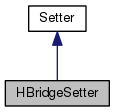
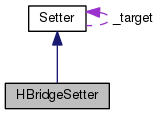
Public Member Functions | |
| HBridgeSetter (Setter *targetA, Setter *targetB) | |
| void | setTargets (Setter *targetA, Setter *targetB) |
| virtual void | input (int value) |
| virtual void | failsafe () |
 Public Member Functions inherited from Setter Public Member Functions inherited from Setter | |
| Setter () | |
| Constructor. More... | |
| Setter (Setter *target) | |
| Constructor with setting the target. | |
| virtual void | setTarget (Setter *target) |
| void | setFailsafeValue (int failsafeValue) |
| Sets the failsafeValue. | |
| int | failsafeValue () |
Additional Inherited Members | |
| Protected Attributes inherited from Setter | |
| Setter * | _target |
| This is the instance of Setter that will be given the transfotmed output value. | |
| int | _failsafeValue |
Detailed Description
Setter class that outputs its value to a HBridge configured on 2 output Setter.
A HBridge is used to drive a motor in forward and reverse directions. It requires 2 Setters as output: one to drive the motor forwards and one to drive it in reverse. When driving forward the reverse output is 0 and vice versa.
Typically the outputs would be AnalogSetters to control a motor through a pair of analog outputs, but could be ServoSetter, AccelStepperSpeedSetter or AccelStepperPositionSetter or any other combination.
Constructor & Destructor Documentation
◆ HBridgeSetter()
Member Function Documentation
◆ failsafe()
|
virtual |
Called when the source of input data is lost, and the Setter is required to fail in a safe way. Calls the failsafes of targetA and targetB
Reimplemented from Setter.
References Setter::failsafe().
◆ input()
|
virtual |
Input the value to be used to set the 2 output Setters. Input of 127 produces 0 on both outputs (stopped) Input of 128 to 255 translates to output Setter A from 0 to 256 and output Setter B at 0 (forward). Input of 127 to 0 translates to output Setter B from 0 to 254 and output Setter A at 0 (reverse).
- Parameters
-
[in] value The input value to set.
Reimplemented from Setter.
References Setter::input().
◆ setTargets()
Set or change the output pin
References Setter::setTarget().
The documentation for this class was generated from the following files:
- HBridgeSetter.h
- HBridgeSetter.cpp